


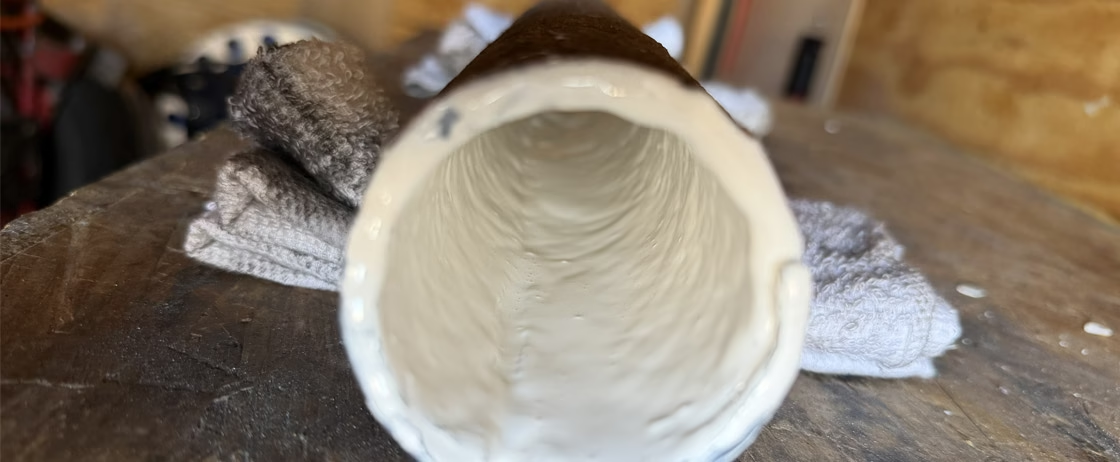
The Moment You Get the Quote
You called a plumber because your drains were slow, or your toilet was backing up, or you noticed a soft spot in the yard. They ran a camera down the line, showed you the corroded cast iron running under your slab, and gave you a number: $50,000 to $75,000 to excavate the floors, replace the pipes with PVC, and restore what they had to tear out.
That’s the moment most South Florida homeowners feel two things at once. Worry about the pipe failure. And shock at the cost. What many don’t realize is that the excavation quote may not be the only option, even if the plumber implied it was.
The Short Answer
In most cases, broken cast iron pipes under a South Florida slab can be repaired with trenchless pipe lining instead of full excavation. Trenchless lining typically costs about $17,000 to $20,000 for a typical 2,000-square-foot home (compared to $50,000 to $75,000 for excavation), takes 2 to 3 days (compared to 4 to 8 weeks), and doesn’t require breaking through the slab, removing floors, or tearing out cabinets.
The four reasons plumbers commonly give for why lining “won’t work” on your specific pipe are often not as absolute as they sound. Here’s what those objections actually mean, and what a trenchless contractor can actually do.
Why South Florida Homeowners Hear “Excavation Only”
Cast iron drain pipes under South Florida slabs fail earlier than in most of the country. The combination of salt-laden air, high groundwater, porous limestone geology, and constant humidity accelerates corrosion, sometimes cutting a cast iron pipe’s usable life from 80+ years down to 30 or 40. Homes built in Broward, Miami-Dade, and Palm Beach counties before roughly 1975 are almost guaranteed to have cast iron drain pipes under the slab, and many are now in active failure. See our full breakdown of cast iron pipe corrosion causing backups for the specifics of how this happens.
That’s the context. What isn’t as widely understood is why a homeowner who calls a general plumbing contractor typically gets an excavation quote rather than a lining quote. Three reasons:
- Most plumbing contractors don’t do trenchless lining.
The work requires specialized equipment (jetters, sanders, epoxy pumping systems, cure monitors) and training that most residential plumbers haven’t invested in. If they can’t do it, they can’t sell it. What they can sell is excavation. - Excavation jobs generate more total revenue.
A $60,000 excavation project involves more billable labor hours than a $18,000 lining project, even if the client is worse off financially. Not every plumber is choosing that math consciously, but the incentive is real. - The technical objections some plumbers raise about lining are misinformed rather than dishonest.
Plumbers who don’t do the work themselves have often absorbed outdated or partial information about what lining can and can’t handle. That’s what the rest of this guide addresses, one objection at a time.
The Four Objections, and What's Actually True
The list below reflects the four most common technical objections plumbers use to steer homeowners toward excavation. Each is drawn from the parent company’s documented rebuttals of these exact claims, based on more than three decades of residential lining work.
Objection 1: “Your pipe has a belly or back-slope, so it can’t be lined”
What the plumber says: The camera shows water pooling in a section of your pipe. That means the pipe has sagged and drainage is going the wrong direction. Lining won’t fix the slope, so you’ll still have backups.
What’s actually true: In most cases, that pool of water isn’t a belly. It’s water trapped in the crack running along the bottom of the pipe. Cast iron corrodes fastest along the bottom (where waste sits longest), and eventually a crack forms there. Water seeps into the crack and gets held by the surrounding soil, which shows up on the camera as a “belly” but is actually a leak.
Once the pipe is lined, the crack is sealed and the interior is smooth. Water flows through without pooling, and the “belly” symptom goes away, because it was never really a slope problem in the first place.
A real belly (a genuine sag in the pipe) does exist in some cases. If it’s severe enough to hold water even after lining, it needs to be addressed separately. But a good trenchless contractor will distinguish a real belly from a corrosion-crack “pseudo-belly” during inspection, and will tell you honestly which one you have.
Objection 2: “Your pipe is too damaged to line”
What the plumber says: There are big holes in your pipe, or entire sections are missing. Lining can’t span holes. You need to replace it.
What’s actually true: Trenchless lining can span holes and missing sections of pipe as long as the surrounding soil is stable enough to support the liner during cure. The lining process uses a resin-saturated felt tube that’s inverted or pulled into place, then inflated against the pipe wall with a bladder. Where there’s a hole in the original pipe, the liner bridges the gap and cures into a structurally sound seamless section.
The liner is engineered to be a stand-alone pipe. It doesn’t depend on the old pipe for structure. That’s exactly why it can handle holes, missing sections, and severely corroded segments.
The one situation where “too damaged” is genuinely true: if entire multi-foot sections have collapsed and there’s no continuous pipe pathway for the liner to travel through, that section needs point excavation before lining the rest. But even then, the excavation is limited to the collapsed section, not the whole system.
Objection 3: “Lining will reduce your pipe’s internal diameter”
What the plumber says: Lining adds material to the inside of your pipe. That makes the pipe narrower, which means slower flow and more clogs.
What’s actually true: The math works out differently than the plumber described.
Before the liner goes in, the pipe is aggressively cleaned. Cast iron pipes that have been corroding for 40 years have significant rust, scale, and buildup on the inside, often reducing the effective internal diameter by 20% or more. That buildup is removed during preparation.
The liner then adds about 3mm (roughly 5 to 6%) of thickness on the pipe walls. Net result: after lining, the pipe usually has a larger effective internal diameter than it did before the work started, plus a smoother surface that improves flow. You’re not losing meaningful capacity.
Objection 4: “Lining only works if the old pipe is still there to support it”
What the plumber says: The lining is basically just a coating. If the old pipe fails, the liner has nothing to hold it up, and it will collapse.
What’s actually true: Modern trenchless liners are engineered to be structurally independent from the host pipe. Once cured, the liner is a rigid, load-bearing pipe in its own right. The same lining systems are approved under ASTM standard F1216 and are used to rehabilitate sewer mains under highways, airport runways, and high-rise buildings, where the old pipe cannot be assumed to provide any support.
Once your cast iron is lined, the liner doesn’t need the cast iron. If the cast iron continues to corrode and eventually crumbles away entirely, the liner keeps functioning as a self-supporting pipe.
When Excavation Really Is Needed
To be honest with you: there are situations where excavation genuinely is the right choice. A trustworthy trenchless contractor will tell you so rather than sell you a lining job that won’t hold up.
Excavation is genuinely necessary when:
- A section of pipe has completely collapsed, leaving no continuous pathway for a liner to travel through
- The pipe route has sharp bends or joints that a liner cannot navigate
- There are multiple severe channel breaks over a short distance
- The system needs to be rerouted or re-graded, not just repaired
Even in most of these cases, a hybrid approach works. Point excavation to fix the specific problem sections, then lining the remainder. That’s dramatically less disruptive and less expensive than full excavation of the entire system.
The right question isn’t “should I line vs. excavate?” It’s “given what’s actually under my slab, what’s the least disruptive, longest-lasting solution?” A contractor who does both approaches has both the incentive and the expertise to answer that honestly.
What to Ask Before Agreeing to Excavation
If you’ve been given an excavation quote, here are five questions to ask before signing anything:
- “Can I see the camera footage of my actual pipe?” Not just a written report. Actual video. This lets you see where the problem sections are, and lets a second-opinion contractor review the same footage.
- “Where specifically is the pipe failing, and how much length is affected?” A quote to excavate the entire system when only 10 feet of pipe is failing is a red flag.
- “Have you considered trenchless lining for this repair? If not, why not?” The answer should be specific to your pipe’s condition, not a general dismissal of the technique.
- “What warranty comes with your excavation work?” Trenchless lining typically carries a 50-year transferable materials and labor warranty. Excavation warranties are often shorter and non-transferable.
- “Can I get a second opinion from a trenchless specialist before deciding?” A confident plumber won’t discourage this. If yours does, that’s information.
Frequently Asked Questions About Broken Cast Iron Pipes
Should I really get a second opinion if I've been quoted for excavation?
Yes. The cost difference between excavation ($50,000 to $75,000) and trenchless lining ($17,000 to $20,000) for a typical home is significant enough to justify a second opinion, even if you ultimately go with excavation. A trenchless contractor can review your existing camera footage and tell you whether lining is an option for your specific pipe, usually within a day.
Does my home insurance affect what repair I can do?
Possibly. In South Florida, most homes 30+ years old require a 4-point inspection for insurance renewal. Failing cast iron pipes are frequently flagged. Documented trenchless lining with a 50-year transferable warranty is typically viewed favorably by insurance carriers. See our guide to whether insurance covers cast iron pipes in South Florida for more.
How do I confirm my cast iron pipes are actually failing?
A video camera inspection is definitive. Cameras inserted through an existing cleanout show the full pipe route, corrosion level, cracks, holes, and channel breaks. Most reputable trenchless contractors offer this service, often free as part of an estimate.
How long does trenchless lining actually last compared to new PVC replacement?
Both are engineered for 50+ years. See our guide to how long trenchless pipe lining lasts for the specifics on longevity, warranty, and how the warranty transfers when you sell the home.
What if my plumber says lining isn't approved for residential use?
Cured-in-place pipe (CIPP) lining has been used in residential, commercial, and municipal applications since 1971. It’s approved under ASTM standard F1216, used by cities across the country for sewer main rehabilitation, and installed in millions of residential systems. It is approved for residential use.
What if my plumber refuses to send me my camera footage?
That’s a significant red flag. You paid for the inspection, and the footage documents the condition of your own home. A plumber who won’t share it may be relying on ambiguity about what the camera actually showed. Request it in writing if necessary.
Get a Second Opinion Before You Sign
If you’ve been told you need to excavate your South Florida slab to repair cast iron pipes, get a second opinion first. Most jobs plumbers quote at $50,000 to $75,000 for excavation can be handled with trenchless lining at $17,000 to $20,000, in 2 to 3 days, without breaking through your floor.
Call (954) 799-4982 or request a free pre-listing camera inspection. We’ve helped South Florida homeowners across Miami-Dade, Broward, and Palm Beach counties save tens of thousands on cast iron pipe repair by identifying the least disruptive fix for their specific pipe. 50-year transferable warranty. No pressure. No excavation quotes.