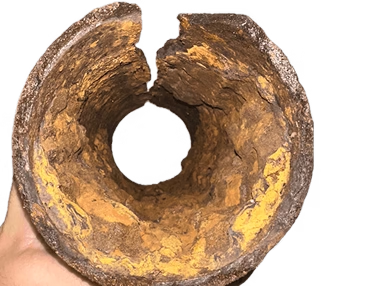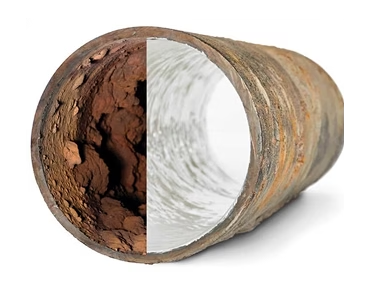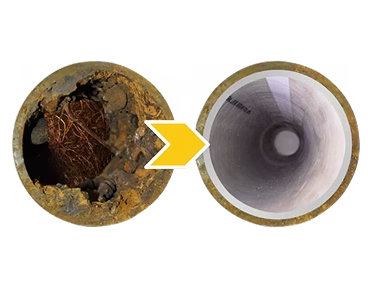
Hollywood’s hard municipal water — among the highest mineral content in Broward County — deposits calcium and magnesium scale on the interior walls of cast iron pipes continuously. This scale narrows the pipe’s effective diameter over years and creates the rough interior surface that catches grease and debris. When a drain feels sluggish again within weeks of a professional cleaning, the pipe’s interior has been compromised beyond what any cleaning can correct. The pipe needs lining, not another service call.
A sewage backup that affects multiple fixtures simultaneously — or that finds its way into a tub, shower, or floor drain — almost always indicates a structural problem in the main drain lateral. In Hollywood Hills and Emerald Hills, where cast iron drain lines from the 1950s and ’60s are now approaching or past 60 years of service in South Florida’s aggressive corrosion environment, this pattern typically signals that internal corrosion has reached the cracking stage and that the pipe itself needs rehabilitation.
Hollywood’s sandy limestone substrate is particularly vulnerable to void formation when a sewer lateral leaks. Unlike clay soil, which tends to hold its shape around a leaking pipe, sandy limestone allows the surrounding material to wash away, creating underground voids that eventually collapse as surface depressions or sinkholes in your yard. If you notice soft spots or ground settling that tracks in a straight line across your yard — particularly between the house and the street — treat it as an active pipe failure requiring immediate attention.
Hollywood’s flat terrain sits at low elevation along the Atlantic coast, making it particularly susceptible to tidal and rainfall-driven water table rises. When king tides or tropical storms push groundwater up through the sandy limestone beneath the city, that pressure forces its way into cracked sewer laterals — and the gas from those joints vents into the home from below the slab. If your sewer odor problem correlates with rain events or king tide cycles rather than appearing consistently, your lateral has a structural breach that groundwater is exploiting.
In Hollywood’s year-round subtropical heat and humidity, a sub-slab drain pipe leak creates conditions for mold growth within 24 to 48 hours. If you’re seeing mold or moisture at baseboard level near bathrooms or along kitchen walls — and your water supply lines have been ruled out as the source — a drain pipe leak beneath the slab is the most likely explanation. In Hollywood’s climate, this situation escalates quickly and warrants immediate investigation.
If your Hollywood home was built before 1980 and has been served by Hollywood’s mineral-heavy municipal water supply throughout its life, its cast iron drain pipes have been simultaneously corroded from without and scaled from within for decades. A camera inspection is the only way to see the actual interior condition — and given Hollywood’s hard water problem, the findings in homes of this era are rarely reassuring.