


The Reserve Study Just Landed on Your Desk
Your Structural Integrity Reserve Study came back from the engineer, and the plumbing section has a number attached to it that changes the entire budget conversation. Cast iron drain pipes are flagged. Estimated replacement cost is somewhere between $1.5 million and $2.5 million. The engineer recommends full excavation and PVC replacement.
You’re now looking at a special assessment large enough to alienate a significant portion of your unit owners, a six-month construction timeline that will disrupt every resident, and a fiduciary decision that will define your term on the board.
Before you present that number at the next board meeting, there’s a second option most engineering reports don’t lead with. It’s worth understanding before your board votes on anything.
The Short Answer
Why Florida Condo Boards Are Getting This News Now
- Post-Surfside legislation made cast iron impossible to ignore
After the 2021 Champlain Towers South collapse, Florida passed Senate Bill 4-D (2022), later refined by SB 154 (2023) and HB 913 (2025). Together, these amendments to Florida Statute 718.112 require every residential condominium and cooperative building three or more habitable stories tall to complete a Structural Integrity Reserve Study (SIRS) at least every 10 years.
The SIRS must cover eight components: roof, load-bearing structure, fire protection, waterproofing, windows and exterior doors, electrical, plumbing, and any other item over $25,000 whose failure would affect those systems. Plumbing is explicitly listed. It’s no longer a category boards can defer indefinitely.
The key change most boards haven’t fully absorbed: for budgets adopted on or after December 31, 2024, associations that must obtain a SIRS can no longer vote to waive or reduce reserves for the components identified in the study. The historical practice of underfunding plumbing reserves and dealing with pipes as an emergency is no longer legally available.
- The buildings this affects were mostly built before 1975
Nearly 40% of Florida homes and residential buildings were built before 1975, when cast iron was the standard drain-waste-vent material. Concentrations of this era of construction are especially heavy in Miami-Dade, Broward, and Palm Beach counties.
Cast iron under Florida buildings corrodes faster than in most of the country because of the combination of salt-laden air, high groundwater, porous limestone soil, and constant humidity. Original 80-year projected pipe life is regularly cut to 30 or 40 years. The buildings now facing SIRS-driven replacement decisions are the ones where the pipes have been failing for a decade or more, but were never funded in reserves.
- The Florida insurance environment made deferral more expensive
Florida property insurance carriers have increasingly identified cast iron plumbing as a claims pattern and are pricing accordingly. Multiple carriers have exited the state entirely; those still writing policies increasingly exclude damage from aging plumbing, raise premiums for buildings with unaddressed cast iron, or refuse renewal.
The net effect: the cost of doing nothing is now visible on your annual insurance bill and on your unit owners’ individual policies. Boards that address plumbing proactively are seeing quieter underwriter conversations. Boards that defer are seeing them get louder every year.
The Special Assessment Math, at Building Scale
| Option | 40-Unit Building Cost | Timeline | Resident Displacement | Approx. Per-Unit Assessment |
|---|---|---|---|---|
| Full excavation + PVC replacement | $1.5M – $2.5M+ | 3 – 6 months | Yes, unit by unit | $35,000 – $60,000+ |
| Trenchless CIPP pipe lining | $400K – $700K | 2 – 6 weeks (phased) | No | $10,000 – $17,000 |
| Difference | $1M – $1.8M saved | ~80% shorter | Removed entirely | $25K – $43K per unit saved |
The building-scale numbers are what makes this decision different from the single-family version of the same question. At a per-unit level, the trenchless option removes the biggest single objection a board faces: the assessment amount that pushes owners toward litigation, sales, or organized opposition.
Per-unit costs vary by pipe length, building configuration, and how much branch line is included in the scope. Our residential trenchless pipe lining base cost starts at approximately $17,000 for a typical single-family home; multi-unit buildings often see per-unit costs lower than that when the vertical stacks and shared branch lines can be lined together in a phased schedule.
The Occupied-Building Question
For single-family homeowners, the difference between trenchless and excavation is real but manageable. For condo boards, it’s often decisive.
A traditional excavation project in an occupied condominium building involves opening slabs and floors on a unit-by-unit basis, working through common areas that residents need daily access to, and coordinating disruption across the entire building for months. In practice, this means:
- Unit-by-unit relocation, often paid for by the association
- Lost rental income for unit owners who rent
- Structured claims from residents whose units become uninhabitable
- Common area closures and disruption to amenities
- Increased security and access control complexity
- Higher probability of legal action from residents
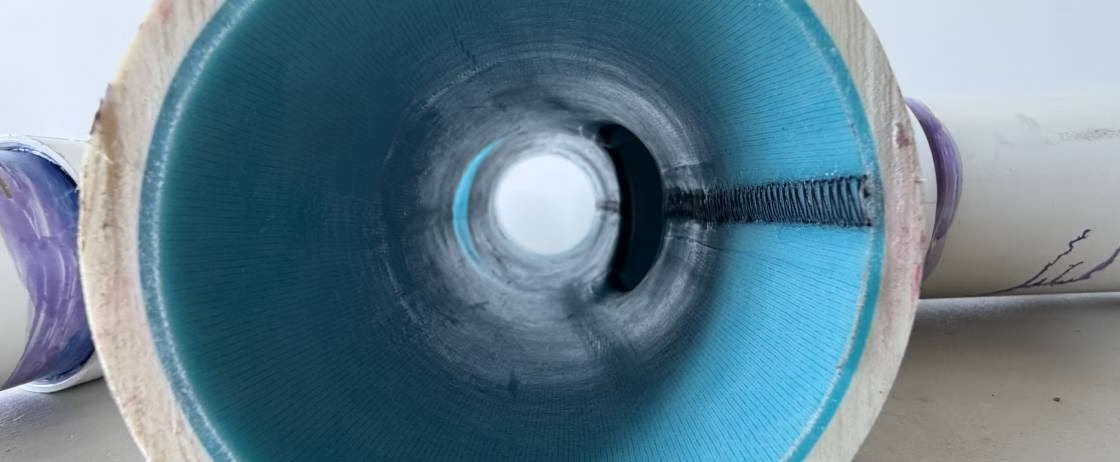
Trenchless lining operates entirely from cleanouts and vent stacks, and the resin cures within about 4 hours per section. Residents typically experience only a few hours of limited plumbing use per day during their unit’s active work window, then normal service resumes. No unit displacement is required. No common areas are closed for extended periods.
For a board weighing options, the difference between “we need to relocate residents for 5 months” and “residents can stay in their units throughout” often outweighs the underlying pipe repair decision itself.
Board Fiduciary Duty Considerations
Florida condominium board directors owe fiduciary duties to the association. Choosing between repair options is not just an operational decision; it is one directors are personally accountable for.
The relevant considerations for a plumbing repair decision typically include:
- Was the decision reached with proper due diligence, including multiple qualified opinions?
- Was the cost difference between options examined and documented?
- Was the disruption to residents evaluated as part of total project cost?
- Does the chosen option include a warranty adequate to the reserve funding assumptions in the SIRS?
- Was the decision documented in meeting minutes with the underlying analysis?
A trenchless lining option that comes with a 50-year transferable materials and labor warranty is generally easier to defend as a fiduciary decision than an excavation option that costs 60% more and produces significantly greater disruption, all other things being equal. The warranty document itself becomes a durable asset of the association and a factor in future SIRS analyses.
Boards that rejected the trenchless option in the mid-2010s often did so on the basis of unfamiliarity with the technology. That defense has weakened materially in the years since. The technology is now approved under ASTM standard F1216, used in high-rise applications, and documented across enough Florida condo projects that “we didn’t know” is no longer a comfortable answer.
What a Proper Building Assessment Involves
- Systematic video inspection of vertical stacks and horizontal branch lines.
Waterproof cameras run through every accessible vertical stack, with documented findings for each. Branch lines serving individual units are also scoped where accessible. - Written condition report suitable for reserve study integration.
The assessment output should include pipe material, corrosion level, structural condition, and estimated remaining useful life for each pipe segment. This documentation can be included in the SIRS record. - Cost estimates for both repair approaches.
A qualified trenchless contractor should be willing to provide comparative estimates for lining and excavation, so the board has documented options rather than a single vendor pitch. - Board presentation availability.
Complex building assessments should be presentable in a board meeting format, so all directors and property management can review findings, ask questions, and vote from the same information base.
Insurance and 4-Point Inspection Implications for Condos
Practically, this shows up in three ways:
- Underwriters looking at a 4-point inspection see “restored” or “lined” plumbing rather than “failing cast iron.” This is generally a positive factor for renewal.
- Some carriers offer improved terms for buildings with documented plumbing rehabilitation. This varies by carrier and is worth confirming with the association’s broker.
- The transferable 50-year warranty conveys to individual unit owners at unit sale, which can support unit resale value and reduce buyer objections.
How to Bring This to Your Board
A more productive process:
- Request the assessment first. Before proposing lining as an alternative, get an actual building-specific assessment on paper. This gives you numbers rather than positioning.
- Bring both options to the same board meeting. Present the excavation cost and the lining cost side by side, along with the disruption profile of each. Boards that see them together generally make different decisions than boards that see them sequentially.
- Include the property manager and the SIRS engineer. They’re going to be involved anyway; bringing them into the assessment conversation early makes the eventual vote cleaner.
- Ask for a board presentation. Complex technical decisions go better when directors can hear the answers directly, ask their own questions, and vote from the same information base.
Frequently Asked Questions
What if we've already committed to a special assessment for excavation?
Can this be done building by building on a schedule?
What if some units have already been individually renovated with PVC?
Does trenchless lining satisfy our SIRS plumbing reserve obligations?
Yes. The relevant question for SIRS compliance is whether the plumbing system has documented remaining useful life aligned with the reserve funding schedule. A trenchless-lined system with a 50-year transferable materials and labor warranty provides a documented 50-year remaining useful life for the lined segments, which typically satisfies the SIRS reserve alignment requirement. Confirm the specific integration with your SIRS engineer.
Can trenchless lining be done in high-rise condos?
Yes. The core CIPP technology has been used in commercial and high-rise applications since the technology was introduced, originally in large-diameter municipal work and later adapted for residential and high-rise systems. Vertical stacks in high-rise buildings are lined section by section on a phased schedule.
How do we know the pipes we can see through the camera actually can be lined?
A pipe is generally lineable if it has a continuous pathway, even if it’s badly corroded, cracked, or has holes. It’s typically not lineable if entire multi-foot sections have completely collapsed, or if the route has extreme bends that a liner cannot navigate. The assessment identifies which segments fall into each category. For a broader look at the technical objections some plumbers use to steer buildings toward excavation, see our related guide on what plumbers may not tell you about broken cast iron pipes under slab.
What if our engineer is not familiar with trenchless lining?
Schedule a Building Assessment or Board Presentation
Call (954) 799-4982 to schedule a building assessment or request a consultation. We work directly with Florida condominium boards, cooperative associations, and property management companies across Miami-Dade, Broward, and Palm Beach counties. Board presentations and property manager consultations available on request. 50-year transferable materials and labor warranty on all lined pipe systems.