


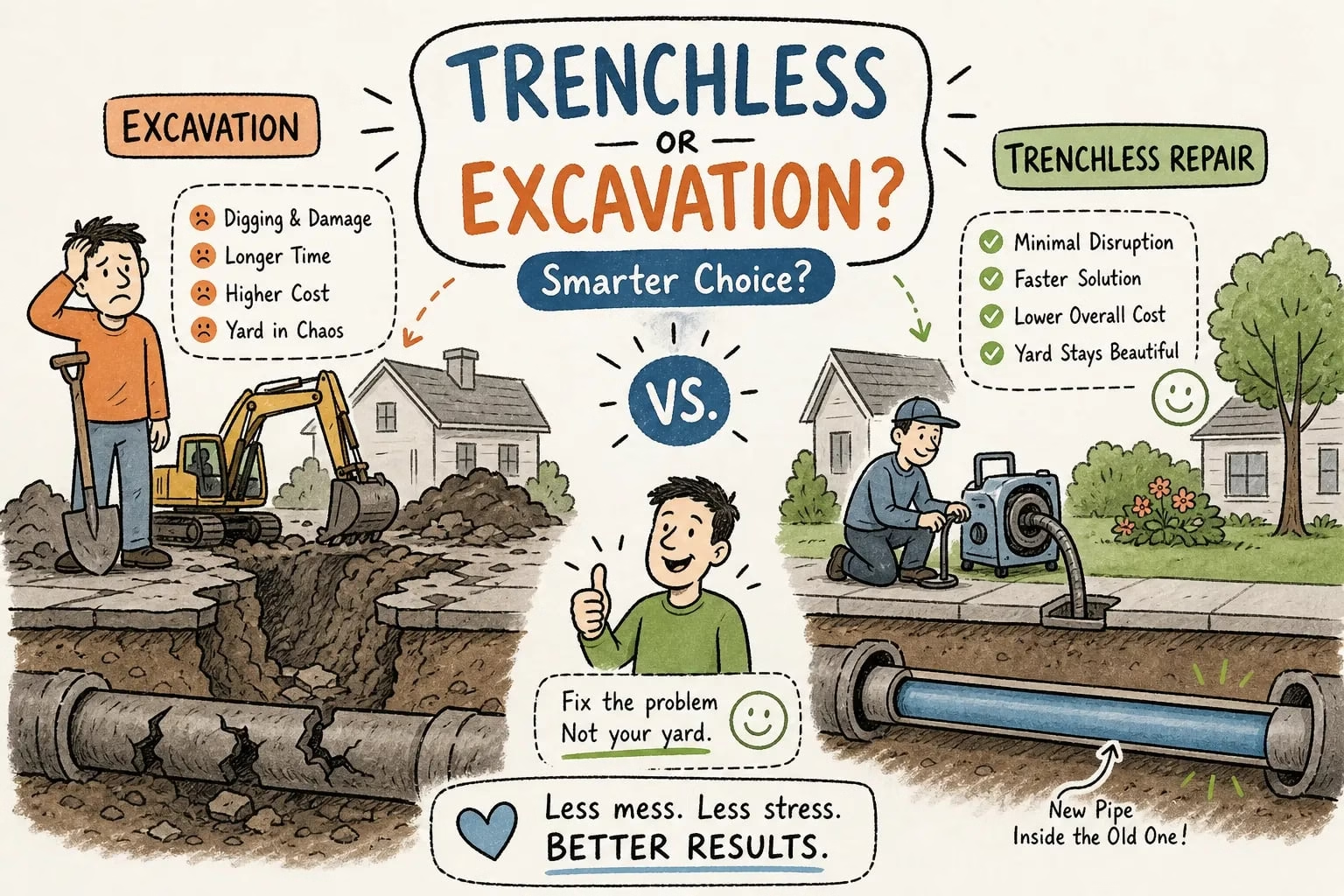
Is trenchless pipe repair worth it vs. excavation? For most South Florida homeowners whose pipes sit beneath tile, terrazzo, a concrete driveway, or established landscaping, the answer is yes. Trenchless methods typically cost 20%–50% less once restoration is factored in, finish in one to two days, and leave floors and yards largely intact.
At Trenchless Pipe Lining South Florida, we see this comparison daily. Our residential CIPP projects complete in 3–4 days, homeowners stay on site with plumbing usable up to 20 hours per day, and every job is backed by a 50-year transferable warranty. That said, trenchless isn’t the right answer for every pipe. This article walks you through real costs, timelines, feasibility factors, long-term outcomes, and the specific questions to ask any contractor before you commit.
Key Takeaways
- Trenchless saves 20%–50% overall: The savings come from avoiding demolition and restoration, not from a lower per-foot plumbing price.
- Trenchless finishes faster: Most residential lining jobs wrap in 1–2 days; full excavation commonly takes 2–5 days plus a separate restoration phase.
- Pipe condition determines feasibility: Fully collapsed, severely deformed, or badly offset pipes may require excavation regardless of cost preference.
- Warranty terms vary widely: A 50-year transferable warranty from a specialist is meaningfully different from the typical one-year workmanship warranty on excavation work.
- Ask for line-item quotes: Bids that omit permits, CCTV inspection, surface restoration, and debris removal are not comparable to those that include them.
Is Trenchless Pipe Repair Worth It vs. Excavation? A Real Cost Comparison
The biggest misconception in this comparison is that per-foot quotes are comparable.
Why excavation bids often look cheaper at first glance
Per-foot excavation quotes commonly exclude permits, surface restoration, concrete cutting, and debris hauling. According to homefixx.com’s 2026 sewer repair cost data, a 50-foot excavation project reaches $16,000–$38,000 or more once restoration is included, with a median near $16,200 for straightforward residential work. That total shifts the trenchless vs. excavation comparison considerably.
In South Florida specifically, the calculation gets worse for excavation. The high water table means trenches encounter groundwater just a few feet below grade, adding dewatering, shoring, and controlled-backfill costs that rarely appear in an initial per-foot quote. Saturated sand is also difficult to compact, so settling and surface cracking after restoration are common follow-on expenses.
What CIPP lining and pipe bursting actually run
The savings are most decisive when costly surfaces must be preserved: original terrazzo, marble, concrete slabs, pavers, or mature landscaping. If the pipe crosses a plain lawn with no pavement, the trenchless advantage narrows. If it runs under a tile kitchen floor or a stamped concrete driveway, the math shifts sharply toward no-dig repair.
The restoration math most contractors won’t show you upfront
Consider the same 50-foot sewer line repaired two ways. The comparison is rarely as close as the per-foot number suggests.
How Long Does Each Method Take? Timeline and Real Disruption
Project days matter, but the daily experience during those days matters more to most homeowners. Here is what each method actually looks like from inside the house.
What happens during a trenchless sewer repair (day by day)
A typical CIPP job begins with a CCTV inspection to confirm pipe condition, followed by hydro-jetting to clean the line. The liner is then inserted, inverted, and cured, with a final video inspection confirming the completed result. For most residential projects, the plumbing restriction window is just part of one day. Our projects at Trenchless Pipe Lining South Florida complete in 3–4 days, with homeowners remaining on site and plumbing usable up to 20 hours per day throughout. The footprint is two small access pits, not a trench across your yard.
What excavation actually looks like from a homeowner’s perspective
Full excavation typically runs 2–5 days for the plumbing phase, followed by a separate restoration phase for concrete, asphalt, or landscaping that may not begin until days later. During that time, driveways can be blocked and walkways impassable. Open trenches present real safety risks in South Florida’s sandy soil: cave-ins, utility strikes, and unstable surfaces are all genuine concerns.
Children and pets need to be kept away from the work zone for the entire duration. The restoration phase then adds another round of contractor scheduling, noise, and access restrictions before the property returns to normal.
When Is Trenchless Repair Not the Right Choice?
A contractor who tells you trenchless works in every situation is not being straight with you. There are real conditions where excavation is the better, or only, answer, and knowing them protects you from a failed repair.
Pipe conditions that rule out no-dig methods
CIPP lining requires the existing pipe to be reasonably round and aligned. Full collapse, severe deformation, heavily offset joints, or missing pipe sections prevent the liner from advancing or bonding correctly. CCTV findings rated as PACP Grade 5 (failure imminent or already present) generally require excavation of the affected section before lining can proceed. Pipe bursting handles more severe deterioration since it fractures and replaces the host pipe, but it still needs a traceable route, completely missing segments or extreme offsets can stop the bursting head before it reaches the exit pit.
Extensive root intrusion does not automatically rule out trenchless. Pre-cleaning with hydro-jetting and root cutting can clear the line for lining in many cases. However, where roots have caused structural voids or damaged nearby utilities, localized excavation may be necessary first.
Site and access factors where excavation wins
When the pipe runs through a bare lawn with no pavement, no finishes, and inexpensive restoration, excavation’s per-foot cost advantage can hold. Pipes requiring significant rerouting, upsizing beyond what bursting allows, or a corrected slope also favor open cut, since trenchless methods follow the existing alignment. Multiple service connections needing excavated reinstatement reduce the no-dig benefit substantially. If the site simply cannot accommodate insertion pits or equipment access, the project needs to be bid as excavation from the start.
How Do CIPP Lining, Pipe Bursting, and Excavation Compare Long-Term?
| Method | Expected lifespan | Typical warranty | Common failure modes |
|---|---|---|---|
| CIPP lining | 40–50+ years | 10–25 years (materials + labor); specialist contractors may offer 50-year coverage | Poor prep, incomplete curing, liner wrinkles, host pipe collapse outside lined section |
| Pipe bursting | 50–100 years (new HDPE pipe) | Varies widely; get it in writing covering pipe and installation | Defective joints, misalignment, utility damage during bursting, grade issues not corrected |
| Traditional excavation | 50–100 years (PVC/HDPE, properly installed) | Often approximately 1 year residential workmanship | Joint leakage, root intrusion, settlement, poor bedding, construction defects |
Lifespan realities for each method
Pipe bursting installs a continuous new HDPE pipe and is closest to full replacement in outcome, with a commonly cited service life of 50–100 years. CIPP is rated 50 years or more when the host pipe is suitable and the installation is properly executed. Conventional PVC or HDPE from open excavation can match either method when bedding, jointing, and slope are correct. Across all three methods, the deciding factor is installation quality and host-pipe condition, which is why vetting the contractor matters as much as selecting the method.
What a 50-year transferable warranty actually means
Most excavation contractors offer approximately one year of residential workmanship coverage. That gap in warranty protection is one of the strongest practical arguments for working with a specialist. At Trenchless Pipe Lining South Florida, our 50-year transferable warranty covers backups, unlimited service calls, and video inspections. That coverage transfers to the next owner, which matters in a high-turnover real estate market like South Florida: it conveys with the home and supports resale value in a way that a one-year workmanship warranty cannot. Before signing any contract, confirm whether warranty coverage is material-only or includes labor, whether it covers leaks and backups, and whether transfer requires registration or a fee.
What Should You Ask Before Choosing a Contractor or Method?
The difference between a fair bid and an expensive surprise is almost always in what the quote excludes. These questions protect you before you commit.
The line items every bid should include
A complete quote should separately identify CCTV inspection and locating, permits, and cleaning. It should also break out access pits or cleanout installation, any excavation required, and lateral reconnections. Finally, confirm that final surface restoration, debris removal, and traffic control (if applicable) are all listed. Omitting these items is precisely how a per-foot trenchless or excavation quote appears affordable on paper but delivers a larger invoice at the end of the job. If a contractor resists itemizing, that is a signal worth taking seriously.
Documentation and red flags to watch for
A trustworthy contractor delivers pre-repair and post-repair video inspection reports, a written warranty that specifies what is covered (materials, labor, leaks, backups, service connections), and verifiable references. Ask for references with real names and phone numbers you can call, not just aggregate star ratings. A contractor confident in their work should be able to provide them readily. Contractors who cannot show a pre-job CCTV inspection, who quote only per foot without specifying exclusions, or who resist putting warranty terms in writing are worth avoiding regardless of their headline price.
The Verdict: Is Trenchless Pipe Repair Worth It vs. Excavation?
Trenchless pipe repair is worth it compared to excavation when the pipe is reasonably intact and accessible, sits beneath costly-to-disturb surfaces, and you want a permanent result with minimal disruption and a strong warranty. For those conditions, the combination of 20%–50% total cost savings, a 1–2-day completion window, and no floor or driveway to rebuild makes the choice straightforward. Excavation remains the right answer for fully collapsed pipes, lines requiring rerouting or slope correction, or sites where restoration costs are genuinely low and the per-foot advantage holds.
For South Florida homeowners dealing with aging cast iron under tile, terrazzo, or a concrete slab, the stakes of choosing the wrong method are real. The high water table, sandy soil, and concentration of pre-1980s homes with original cast iron plumbing make this a region where the trenchless vs. excavation decision has consequences that outlast the repair itself.
Before committing to either option, get in touch with our team at Trenchless Pipe Lining South Florida. A CCTV inspection will confirm whether your pipe is a candidate for no-dig sewer repair, and a line-item quote will give you a genuine cost comparison to evaluate against any excavation bid, so you have the full picture in hand before any work begins.
Frequently Asked Questions
How do permits and dewatering affect the final cost of excavation in South Florida?
Permits and dewatering can materially increase the final excavation cost. In South Florida the high water table often requires dewatering, shoring, and controlled backfill, items that rarely appear in an initial per‑foot quote, so those add-ons push straightforward excavation totals well above the headline number. Always expect those site‑specific items to be itemized or your comparison to trenchless will be misleading.
If the pipe is partially collapsed, can pipe bursting still be used instead of excavation?
Possibly, pipe bursting handles more severe deterioration than lining but it still has limits. Bursting fractures and replaces the host pipe and can work where deterioration is significant, but it requires a traceable route; completely missing segments or extreme offsets can stop the bursting head and force excavation of the affected section.
Will we be able to use our plumbing while a trenchless repair is underway?
Yes, you can usually use most plumbing during trenchless repairs with only short restriction windows. Typical residential CIPP jobs have a brief plumbing restriction for part of one day and our projects let homeowners remain on site with plumbing usable up to about 20 hours per day during the 3–4 day process.