


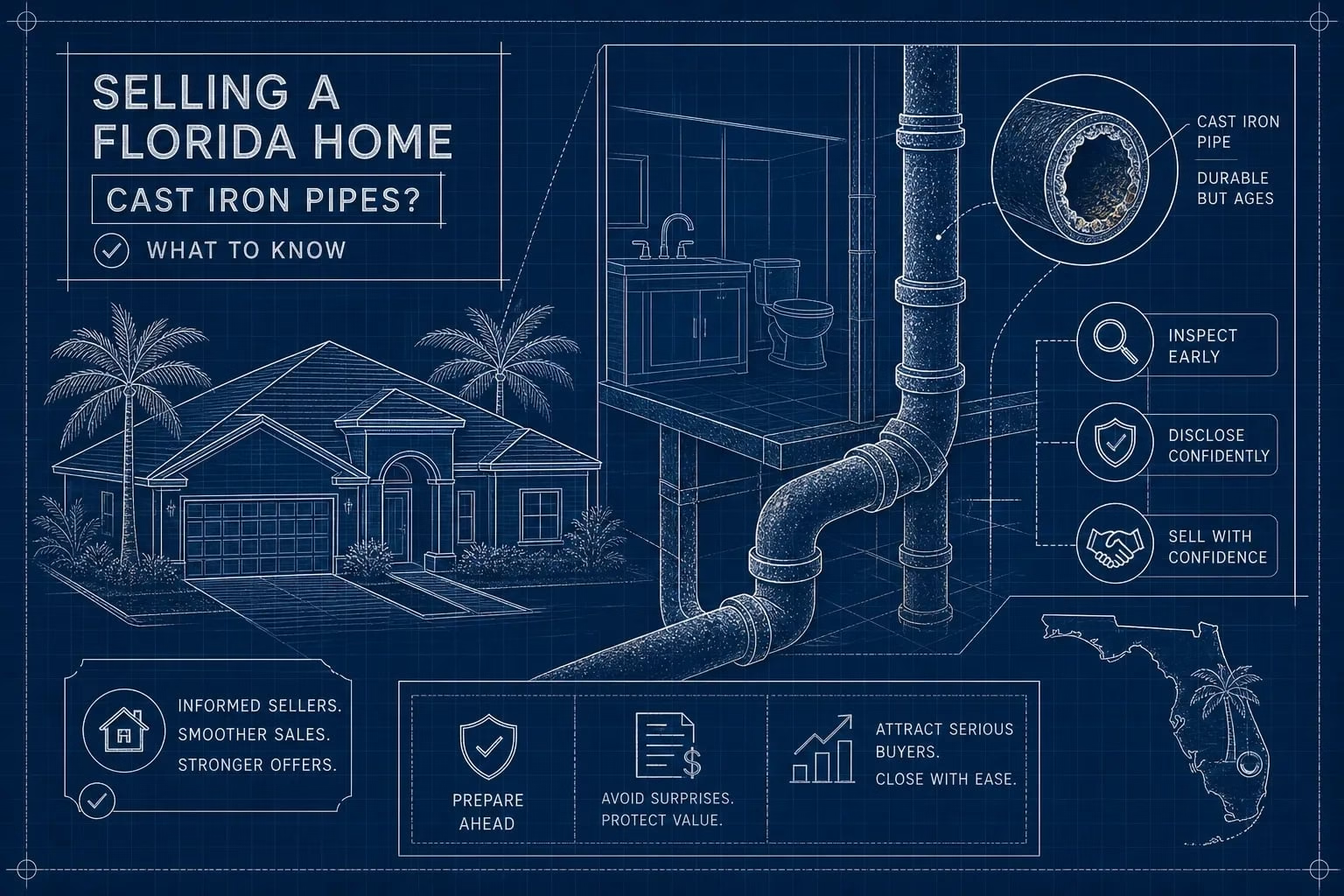
In a cast iron pipe home sale Florida situation, the scenario is all too familiar: a buyer’s inspector scopes the drains on a pre-1980 home, flags corroded cast iron, and suddenly the seller is fielding credit demands or watching the contract fall apart. If your home was built before 1980 in Miami-Dade, Broward, or Palm Beach County, research and trade guidance indicate many of these homes still have their original cast iron drain system. As of 2026, those pipes are anywhere from 40 to 85 years old. They were designed for a different era, and South Florida’s climate has not been kind to them.
The good news is that sellers who understand what they’re dealing with can address it strategically, protect their asking price, and close on time. Trenchless Pipe Lining South Florida has made it possible to resolve inspection failures in a matter of days without demolishing floors or derailing a closing timeline. This guide walks you through what inspectors find, what Florida law requires you to disclose, what repairs actually cost, and which seller strategy makes the most financial sense for your situation.
Why cast iron pipes complicate a South Florida home sale
South Florida’s combination of high humidity, salty coastal air, acidic sandy soil, and a high water table accelerates cast iron corrosion far faster than cooler, drier climates. A pipe system rated for 50 to 75 years under ideal conditions can show critical failure in 25 to 30 years here. That timeline means a significant number of homes currently on the market have drain systems already past reliable service life, even if the seller has never experienced a single backup.
The friction this creates in a real estate transaction goes beyond the pipes themselves. Appraisers note deferred maintenance, and a flagged plumbing system can push a home below market comps or trigger lender conditions. Buyers using FHA or VA financing often face underwriting requirements that the plumbing system be in serviceable condition, which turns a repair recommendation into a closing condition. When buyers see “cast iron drain pipes, corrosion noted” in an inspection report, many assume worst-case repair costs and respond with a lowball credit demand or a cancellation notice.
Sellers who already know their pipe condition before they list flip that dynamic entirely. Documentation of a completed repair or a professional evaluation puts the seller in control of the conversation rather than scrambling to react to findings from the buyer’s inspector under deadline pressure.
Cast Iron Pipe Home Sale Florida: What Inspectors Actually Find
A standard home inspection often does not include a sewer scope, but any buyer’s agent familiar with South Florida housing stock will recommend one for a pre-1980 home almost every time. Sellers who understand what these inspections reveal are in a far better position to get ahead of the report before a buyer orders one.
Camera scope vs. hydrostatic test: what each finds
A sewer camera scope is the most direct diagnostic tool available. The camera travels inside the drain lines and visually confirms cracks, joint offsets, root intrusion, corrosion scaling, bellies, and collapse points. In South Florida, a camera inspection typically costs $150 to $400. A hydrostatic test is the more definitive structural test: it fills the drain system with water to confirm whether it holds pressure or leaks, and usually runs $200 to $500. Both tests together give a complete picture of the system’s condition, and sellers can order them proactively as a pre-listing inspection to control the narrative before a buyer’s inspector does.
The most common findings in South Florida camera inspections include significant internal corrosion, channeling (the gradual loss of the pipe floor from years of acidic waste exposure), cracked or offset joints, root intrusion, and in more advanced cases, partial or full pipe collapse under the slab. Even a partial failure is enough to trigger an inspection contingency response from a buyer. A documented pre-listing scope paired with a completed repair turns an unknown liability into a documented asset.
What Florida law requires you to disclose about plumbing
Florida law requires sellers to disclose known material defects that are not readily observable and that a buyer would not discover through a reasonable inspection. Plumbing system condition falls squarely within this standard. Many sellers underestimate how broad that obligation is, and the consequences of getting it wrong are serious.
If you know your cast iron drain system has chronic backups, active leaks, significant corrosion, or a prior repair history, that information must be disclosed before a contract is executed. Florida also has a specific statute requiring disclosure of known defects in the sanitary sewer lateral. Sellers who fail to disclose and whose buyers discover the problem after closing can face legal claims for fraudulent concealment. The risk is real and well-documented in Florida real estate disputes.
There’s a common misconception worth addressing directly: selling “as-is” in Florida does not waive your disclosure duty. An as-is contract simply means you won’t make repairs. It does not mean you can stay silent about known defects. If you know the cast iron system is failing, that disclosure still has to be made. Sellers who disclose proactively and pair that disclosure with documentation of a completed repair or professional evaluation stand on stronger legal and negotiating ground.
Cast Iron Pipe Home Sale Florida: Repair Costs & Options
Sellers who understand the real cost numbers before they’re in a reactive negotiation make better decisions. There are three main repair paths, each with very different price points and timelines.
Full repipe costs
A full cast iron repipe or replacement in Miami-Dade and Broward typically runs $10,000 to $30,000 or more, depending on home size, access, and what it costs to restore the flooring, drywall, and fixtures disturbed during excavation. This option is maximally disruptive and generally takes weeks to complete.
Trenchless lining costs
Trenchless CIPP lining runs $4,200 to $13,650 in the Miami market, requires no floor demolition or slab cutting, and most residential jobs are finished in three to four days with homeowners staying in the home throughout. A partial repair targeting only an isolated damaged section can run $375 to $8,000 or more depending on accessibility and scope, but it’s only the right choice when the rest of the system is genuinely serviceable.
The seller-specific math on trenchless lining is worth spelling out. Beyond the higher upfront price, excavation means tearing up tile, terrazzo, or marble floors that can cost additional thousands to restore. In South Florida homes with original terrazzo or marble, floor restoration alone can rival the pipe repair cost. Trenchless lining eliminates that collateral damage. Often significantly less expensive than full excavation, with a completion window that doesn’t stall a closing timeline, lining is the option that keeps sellers in control of their sale and their budget.
Choosing your seller strategy: fix, credit, or list as-is
Once you know the pipe condition and the realistic cost to address it, the strategic decision becomes straightforward. Three paths are available, each carrying different risk and reward depending on the market, the buyer, and your timeline.
Fixing before you list is the strategy that preserves the most asking price and gives you the most leverage. A pre-listing trenchless lining job resolves the inspection issue before a buyer ever sees the report. Most jobs complete in three to four days with no floor damage. Trenchless Pipe Lining South Florida backs every job with a 50-year transferable warranty, so the new owner inherits that coverage and can verify the terms directly with the company. That warranty becomes a marketing asset: you can document and disclose a recently rehabilitated plumbing system with a half-century of coverage that transfers to the new owner. In a market where buyers are cautious about aging infrastructure, that documentation often justifies holding the asking price firm.
Offering a closing credit is the path sellers choose when they don’t want to manage repairs before closing. The downside is real: buyers typically inflate their credit requests to account for uncertainty and the hassle of managing a repair themselves. Consider a hypothetical where a seller offers a $10,000 credit for a job a specialist might complete for $6,500, that seller is leaving meaningful money on the table. The liability also doesn’t fully transfer because the sale closes with a known deficiency rather than a resolved one.
Selling as-is with known cast iron problems is a legitimate option, but go in with clear eyes about what it does to your net proceeds. Buyers factor in the worst-case repair cost plus their inconvenience premium. In South Florida’s competitive market, a documented plumbing repair almost always yields a better net result than selling as-is with a flagged system. For most sellers here, as-is turns out to be the most expensive path, not the easiest one.
The insurance and warranty angle that buyers actually care about
Two financial factors shape buyer confidence beyond the repair itself: how insurance treats the pipes going forward, and whether the repair carries a warranty that survives the sale.
Florida homeowners insurers generally treat cast iron pipe failure as a wear-and-tear exclusion. The corroded pipe itself is typically not covered; the water damage it causes may be covered depending on the policy and the suddenness of the event. Sewer backup coverage is usually a separate endorsement. This matters to sellers because buyers researching a home with flagged cast iron pipes may find that standard insurance won’t cover future pipe failures. Some Florida carriers require pipe replacement before issuing a new policy at all. A seller who has already relined the system with a modern epoxy liner can substantially reduce buyer and insurer concerns, particularly when the work is supported by video documentation, a transferable warranty, and permit records, though lenders or insurers may still request verification.
CIPP lining systems from reputable specialists carry 50-year design life ratings. For buyers using conventional financing, that documentation signals that the plumbing infrastructure is not a risk. For sellers, it’s a concrete differentiator: instead of disclosing a problem, you’re disclosing a solution with five decades of coverage behind it. In a relatively high-turnover real estate market like South Florida, where properties frequently change hands within a few years, that transferable warranty can enhance buyer confidence and potentially support resale value in the next transaction as well.
Your action checklist before you list
The decision path here is straightforward. Order a pre-listing camera scope for $150 to $400. Understand what it shows. Decide on your repair strategy before a buyer’s inspector forces your hand. If the system shows corrosion, channeling, or a history of backups, trenchless lining often costs significantly less than a full repipe, can be completed in days, preserves your floors, and, when the liner qualifies, produces a long-term transferable warranty that supports your asking price. Confirm specific timelines and warranty terms with your chosen contractor, since suitability depends on pipe condition; fully collapsed lines may still require replacement.
Handling a cast iron pipe home sale Florida challenge proactively, rather than waiting for a buyer’s inspector to surface the issue, means you negotiate from strength instead of scrambling under time pressure with a buyer who is already alarmed. Sellers who treat cast iron pipes as a manageable problem rather than a deal-killer close faster and net more.
Trenchless Pipe Lining South Florida offers free consultations and video inspections for sellers preparing to list. Contact our team to get a full assessment before your home hits the market, and ask about callback availability and emergency service options so pipe condition never puts your sale at risk.