


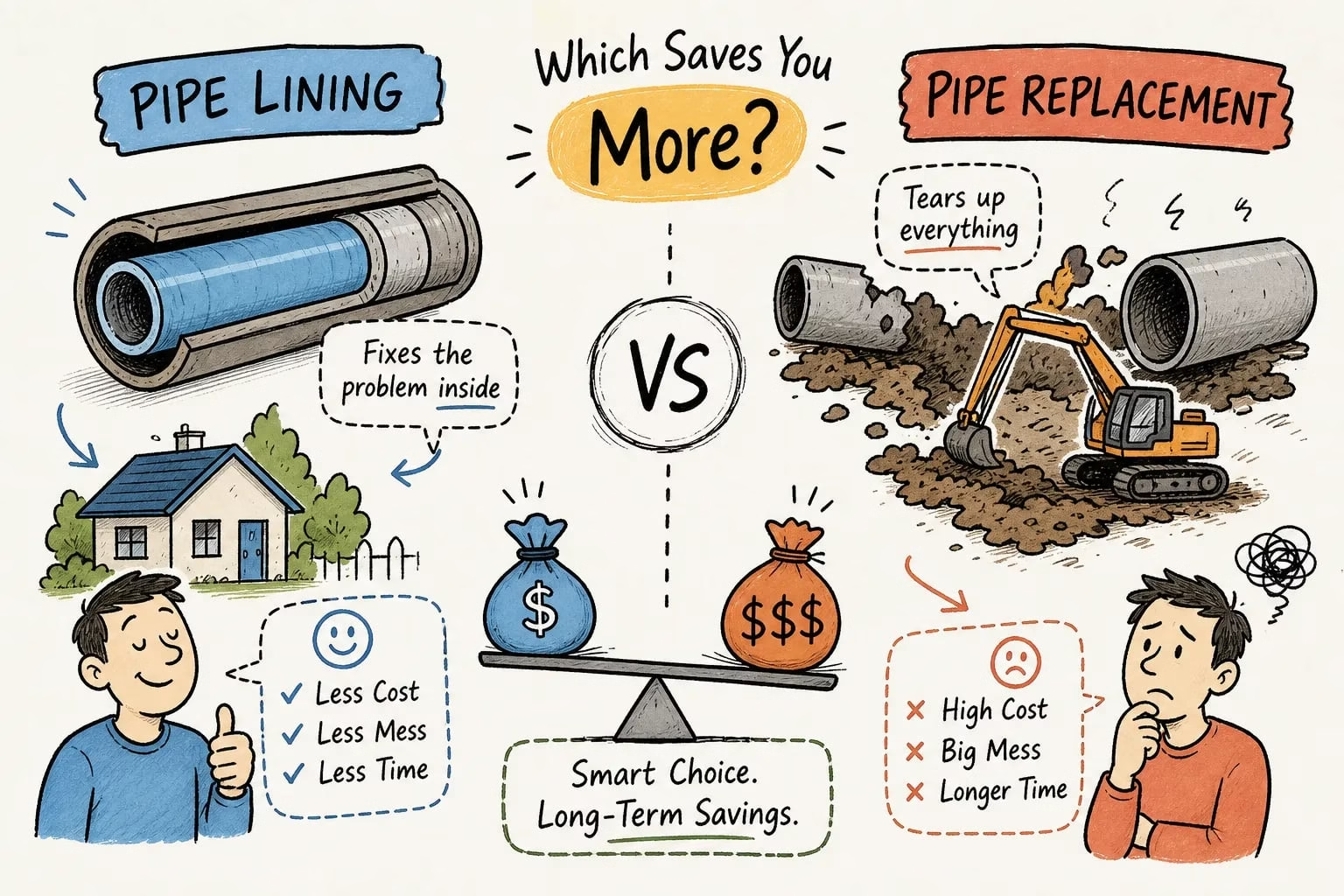
A plumber hands you a camera inspection report and two quotes. One involves jackhammering your floors. The other doesn’t. The price difference is staggering, and you have no idea which one you actually need. If you’re weighing pipe lining vs replacement, you’re not alone, at Trenchless Pipe Lining, we hear from homeowners in exactly this situation regularly, and the complaint is almost always the same: nobody explained the difference between the two options. This breakdown gives you the honest comparison.
The decision between trenchless pipe rehabilitation and full excavation ultimately comes down to what your pipes look like on camera, what your total budget actually includes, and how much disruption you can absorb. Getting those questions wrong costs homeowners tens of thousands of dollars. Getting them right means a permanent fix that’s done in days, not weeks.
What pipe lining and full replacement actually involve
Before you can evaluate a quote, you need to understand what each method physically does to your plumbing system and your property.
How cured-in-place pipe lining (CIPP) works
Cured-in-place pipe lining is exactly what it sounds like. A technician inserts a flexible liner saturated with epoxy resin into the existing pipe, inflates it against the pipe walls, and cures it in place using heat or UV light. The result is a new pipe formed inside the old one, smooth, jointless, and resistant to corrosion and root intrusion. Access happens through existing cleanouts or small entry points, so no digging through your slab, driveway, or yard is required.
What full sewer excavation and replacement involves
Open-cut replacement is effectively a two-job project. First, workers trench or tunnel through soil, concrete slabs, driveways, or landscaping to expose the failed pipe. They remove it, install new PVC or ABS pipe, and backfill the trench. Then the second job starts: restoring everything that was disturbed. Concrete patching, driveway repair, and landscaping restoration are separate costs that many base quotes don’t fully capture upfront.
When each method applies
CIPP works on most residential drain and sewer laterals, including cast iron, clay, and concrete pipe. It’s the right fit when the pipe is deteriorating but structurally intact enough to accept a liner. Full replacement is the only option when you wait too long and the structural integrity is too compromised for a liner to adhere and function correctly. A CCTV video inspection of the interior is what determines which category your system falls into, and any reputable contractor starts there before recommending either path. We offer free sewer scope inspections to determine if the pipe is a good candidate for lining.
Pipe Lining vs Replacement: The True Cost Gap
The per-foot numbers only tell part of the story. Once you account for what excavation does to everything above the pipe, slabs, driveways, landscaping, finished floors, the total cost increases dramatically.
What CIPP lining costs on a typical residential job
In Florida in 2026, trenchless pipe lining runs approximately $150 to $250 per linear foot, with most residential projects landing between $5,000 and $15,000 total. A common 50-foot sewer lateral falls in the $7,500 to $12,000+ range. Price varies based on pipe diameter, depth, number of bends, and access conditions, but the scope of work stays contained to the pipe itself, no surface restoration required.
Why full replacement costs more than the base quote suggests
Open-cut replacement starts at $200 to $300+ per linear foot for the pipe work itself. When that line runs under a concrete slab, cutting and restoring the concrete adds another $310 to $350 per linear foot for the affected section. Landscaping restoration after sewer work adds $1,200 to $6,200 on top of that, depending on what’s disturbed. In our experience, homeowners often find those line items broken out only after the project is done and the final invoice arrives, a pattern worth anticipating before you sign anything.
Why the real savings gap is wider than it looks upfront
When you compare apples to apples, pipe work plus full surface restoration, trenchless relining can cost roughly half of what full excavation runs once all the associated work is included. To illustrate: for a 3-bedroom South Florida home with cast iron running under original flooring, an excavation project accounting for slab cuts, pipe removal, concrete restoration, flooring replacement and surface repair can reach $50,000 to $75,000 based on component pricing. CIPP or epoxy pipe lining for the same home, based on the same line-item estimates, typically lands in the $15,000 to $25,000 range. That gap reflects two things: no slab cuts and no surface restoration bill.
Timeline and disruption: what each method does to your home
Cost matters, but so does how long your home functions as a construction site. For families with children, tenants, or anyone working from home, the disruption calculation is just as important as the price.
How long a trenchless lining job takes
Most residential pipe lining projects are completed within two to three days, and you can stay in the house while the work issuing completed. There are no open trenches, no concrete dust spreading through living areas, and no waiting weeks for a contractor to return and patch the floor. Homeowners stay in the house throughout the process.
What open-cut replacement does to your property
Excavation-based replacement typically runs three to seven days for the pipe work alone. If the sewer runs under a slab, driveway, or landscaped yard, full restoration can stretch the disruption into additional weeks. During that time, sections of the home may be inaccessible, plumbing service is interrupted for extended periods, and the property looks and functions like an active construction zone.
The hidden cost of staying elsewhere
With CIPP lining, homeowners generally remain on-site with plumbing service restored the same day or within 24 hours. With open-cut work, some homeowners choose to leave temporarily, particularly when interior slab cuts are involved. Hotel stays, meals out, and lost work time add up fast and rarely appear as a line item in any contractor’s quote. This is a real cost of excavation that almost never gets factored into the comparison.
When pipe lining vs replacement tips toward excavation
A trustworthy contractor tells you when your pipe is not a candidate for lining, and explains exactly why. Here are the conditions that take pipe lining off the table, along with what a proper inspection should reveal.
Pipe conditions that rule out CIPP/Epoxy lining
CIPP/epoxy lining cannot fix a pipe that has completely collapsed. The liner needs a stable, continuous surface to adhere to, and a fully collapsed section provides neither. Severe joint offset, where pipe sections have shifted significantly out of alignment beyond roughly 25 percent of the pipe diameter, usually requires excavation to correct the misalignment before any rehabilitation can work. When root intrusion has physically destroyed sections of the pipe wall rather than simply growing through joints, the structural integrity needed to host a liner is gone. These are hard limits, not judgment calls that vary by contractor.
How a video inspection determines which method your system actually needs
A video inspection documents the interior condition of every foot of pipe, identifies structural failures versus surface deterioration, and pinpoints offset joints, collapse points, and the severity of root intrusion. Reputable contractors provide this footage as part of their standard evaluation, not as an add-on charge. If someone quotes you a price for either method without a video inspection first, that’s a red flag regardless of which direction they’re recommending.
How a South Florida homeowner saved over $40,000 by going trenchless
Numbers are easier to evaluate when they’re attached to a real situation. The following example reflects the kind of pipe repair vs full replacement decision that many South Florida homeowners with aging cast iron systems are navigating.
The situation: failing cast iron under original terrazzo floors
A homeowner in Miami-Dade with a 1960s concrete block home called after repeated drain backups across multiple fixtures. A CCTV inspection revealed heavily corroded cast iron drain lines running beneath 800 square feet of original terrazzo. Two excavation contractors quoted between $55,000 and $62,000, which included slab cuts, pipe removal, concrete restoration, and partial terrazzo resurfacing. Neither contractor could guarantee the terrazzo color or pattern would match after the work was done.
The trenchless alternative: what we proposed
Trenchless Pipe Lining assessed the same system and confirmed via video inspection that the pipes, while heavily corroded, retained enough structural integrity to accept a cured-in-place liner. We quoted the full job at approximately $16,500. The terrazzo remained completely untouched. Work was completed in four days, and the homeowner stayed home the entire time with plumbing available throughout.
The outcome: restored pipes, preserved finishes, and a long-term warranty
The total savings came to more than $40,000. Beyond the cost difference, the job came with a 50-year transferable warranty on the liner itself, with warranty terms documented in writing before work began. When the property later sold, the warranty transferred to the new owner, turning the plumbing system from a liability on the inspection report into a documented asset, a different conversation entirely when you’re sitting at the closing table.
The questions to ask before signing any pipe repair contract
Whether you’re evaluating a quote from us or from anyone else, these are the questions that separate thorough proposals from ones that will surprise you later.
What a legitimate quote should always include
Ask every contractor for a pre-repair video inspection report before accepting any proposal. The written quote should specify the method being used, the pipe diameter and total linear footage covered, and exact warranty terms, including duration, what’s covered, and whether the warranty transfers to a future owner. It should also list access point locations and itemize what surface restoration is included. If restoration costs aren’t broken out separately, ask for that in writing before you sign.
Red flags and warranty details that matter most
A short warranty or no warranty on a CIPP job is a red flag worth taking seriously. Some providers offer 50-year transferable warranties on residential cured-in-place pipe work; warranty availability and terms are provider-specific, so ask for the language in writing. Any contractor who can’t supply verifiable references is one to walk away from. Price alone is not a reliable indicator of quality, the cheapest CIPP bid and the cheapest excavation bid are often the ones that cut corners on inspection, warranty, and restoration scope.
Making the right call for your home
When weighing pipe lining vs replacement, the answer for most South Florida homeowners with deteriorating but structurally intact cast iron will lean toward trenchless rehabilitation. CIPP costs significantly less when all associated work is included, preserves your floors and finishes, and wraps up in days rather than weeks. Full replacement is necessary when pipes have truly failed beyond what a liner can address, but that determination should come from a camera, not from a contractor’s preference or a quote written before anyone looked inside the pipe.
The only reliable way to know which category your system falls into is a video inspection from a contractor who will hand you the footage and explain exactly what it shows. At Trenchless Pipe Lining South Florida, every evaluation starts there. We offer FREE consultations and pre-work video inspections, and we can connect you with verified references from completed jobs before you make any commitment. Reach out to our team to schedule yours.